
Looks like Jeff Bezos is getting some competition for the top couch spot in the billionaire lounge.
Google’s Sergey Brin just nudged past him by $100 million.
- Giving away last-minute sales 😤
- Your 2026 profits need barcodes 💳
- Amazon crash test ready? 🤯
- 30-minute delivery is here ⚡

AMAZON NEWS
Amazon is officially retiring commingling across its entire fulfillment network by March 31, 2026. This update comes as faster delivery can now be achieved without mixing units from different sellers.
👋 Hello barcodes
Commingling always carried one major risk: counterfeit items slipping into orders. Amazon’s fix? Updated barcode rules that all sellers will need to follow once commingling ends.
- More flexibility. If you’re in Brand Registry with Brand Representative status, you won’t need Amazon barcodes for products that already have manufacturer barcodes.
- Amazon barcodes required. If you’re not in Brand Registry, you’ll need Amazon barcodes, even for products that already have manufacturer barcodes.
- No barcode? No problem. Both brand owners and resellers must use Amazon barcodes on any product that lacks a manufacturer barcode.
✨ The good in this goodbye
Ending commingling means more accurate inventory and fewer quality risks from other sellers’ units. Brand owners gain a smoother path for multi-channel operations, while resellers need to prepare for the extra labeling steps.
With the 2026 cutoff approaching, now’s the perfect time to review your catalog, labeling workflow, and Brand Registry status to stay ahead of potential disruptions.
TOGETHER WITH THREECOLTS
"Gut feeling" isn't an inventory strategy
It's the middle of Q4. Your bestseller is flying. 🚀
But when do you restock for Christmas? How many units do you send?
You're just... guessing, aren't you? 🤔
"Gut feeling" is how you stock out on December 15th, handing all the most profitable, last-minute sales to your competitor.
It's also how you send 1,000 units, sell 300, and get crushed by January storage fees. Both are business-killers.
InventoryLab (included in Seller 365) stops the guessing.
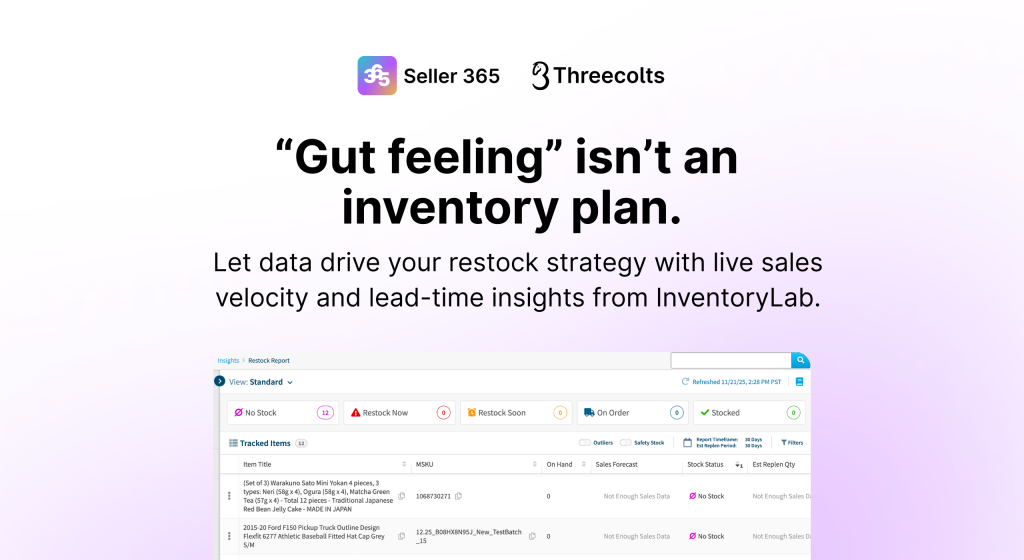
Its Restock Report is your data-driven command center.
It analyzes your live sales velocity and lead times to give you actionable restock recommendations. Then, it tells you what to reorder, when, and how many units to send to stay profitable.
Stop guessing and start planning.
BITES OF THE WEEK
- Passkey Protection: Amazon Seller Central adds password-free Passkey login for stronger, faster, and safer account access.
- AI Energy Boost: Amazon scales BrainBox AI after pilot cuts grocery center energy use by nearly 15%.
- Holiday Extension: Extended FBA and Prime shipping cutoffs give sellers two extra days for holiday sales.
- Smarter Selections: New ASIN Inclusion lets FBA sellers selectively enroll products to boost returns recovery.
TRENDING TOPIC
Could your shipments survive Amazon crash tests?

In a warehouse south of Seattle, Amazon is putting boxes through their literal torture.
The Packaging Innovation Lab tests products to survive all the bumps, drops, and shakes of delivery. At the same time, the team is working to shrink cardboard, cut plastic, and eliminate wasted space.
💥 How the chaos works
Inside the 10,000-square-foot lab, boxes face extreme tests:
- Stacked under the weight of a small car
- Squeezed until their sides bow
- Shaken on vibration tables mimicking trucks and planes
- TVs get strapped to incline impact machines to simulate a truck slamming on the brakes
🌱 The sustainability angle
Well, it’s not like Amazon is doing this for nothing. Their ultimate goal is safer deliveries, less packaging waste, and more efficient shipping.
- 18M products are certified to ship in their own packaging.
- About 12% of Amazon’s global shipments went without extra packaging last year.
- Since 2015, Amazon has saved 4.2 million metric tons of packaging and reduced North American single-use plastics from 65% of shipments in 2023 to 37% in 2024.
- Hundreds of machines now produce custom paper bags, replacing 15 billion plastic air pillows every year.
Your holiday orders are more likely to arrive intact, and with less waste, because Amazon already put them to the test first.
HOT TOPIC
Amazon and Walmart race to 30-minute delivery

Amazon and Walmart are in a new kind of battle, and this time it’s a race to see who can get orders to shoppers’ doors the fastest.
In a Business Insider interview, analysts questioned whether 30-minute delivery is a true game-changer or just an expensive experiment.
🚀 The ultrafast delivery experiment
Only companies with large networks and massive inventory, like Amazon and Walmart, can offer ultrafast delivery.
Their dense store footprints help:
- Walmart: 4,600 stores
- Target: 2,000 stores
This proximity enables faster delivery, a scale smaller players can’t match.
- Amazon: testing 30-minute delivery in Seattle and Philadelphia
- Walmart: fulfilled a Black Friday order in 10 minutes and is expanding drone delivery in Atlanta
Success relies on massive inventory near dense populations. While this works in global markets like China and India, U.S. suburbs remain a bigger challenge.
🛒 Delivering retail truth
Ultrafast delivery isn’t just about speed, it boosts existing grocery and marketplace strategies. Giants with scale and dense networks have the edge, while smaller players struggle.
It’s not a guaranteed profit driver, but it strengthens the strategy for those who can execute it.